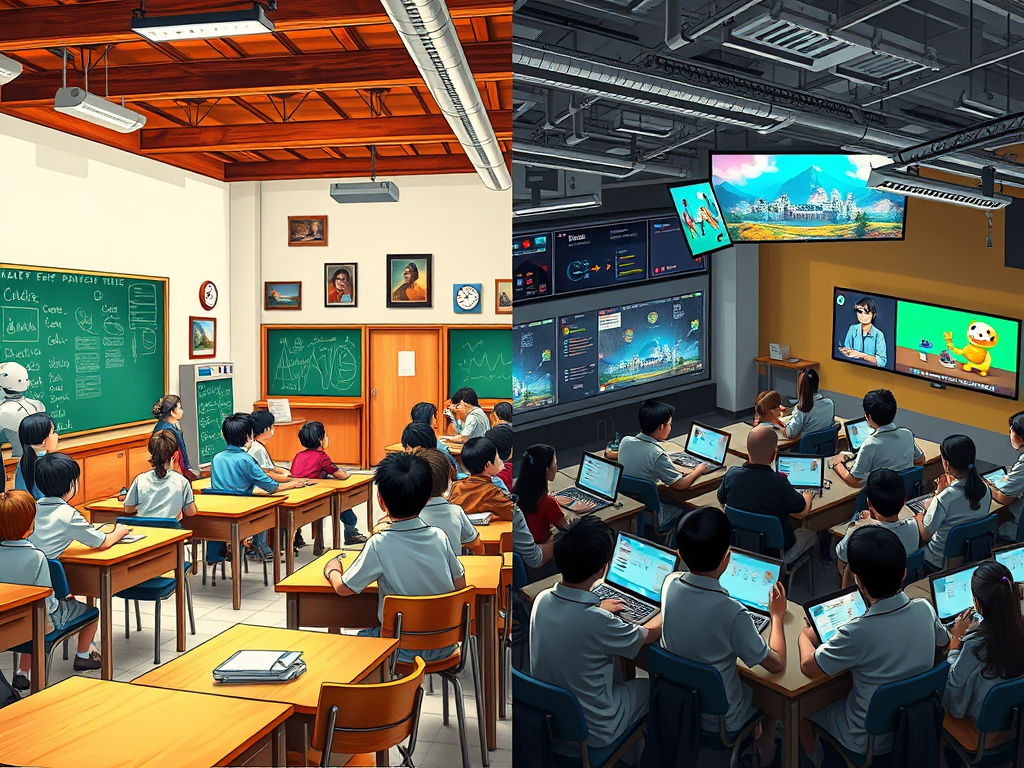
Education has always been the backbone of society, shaping not only knowledge but also values, discipline, and creativity. Over time, the way we teach and learn has changed dramatically. From the simplicity of traditional classrooms to the dynamic, technology-driven lessons of today, each era has its strengths and weaknesses. Let’s take a closer look at how education has evolved—what we gained, what we lost, and what we can learn from both.
Education in the Past
Good Points
– Attentive Teachers: Education was traditional, but teachers were genuinely helpful and attentive to students.
– Respected Figures: Teachers held a high status in society.
– Discipline and Order: Teachers maintained discipline and instilled lifelong habits such as punctuality and neat handwriting.
– Community Connection: Many taught in small schools and knew families personally.
– Support for Weaker Students: Teachers often gave extra time to struggling learners.
– Simplicity and Dedication: Most teachers did not seek extra income through tutorials; they were satisfied with their salary and rewarded through respect or gifts from grateful students.
– Collaborative Classmates: Peer-to-peer learning was strong, with students helping each other on creative or difficult tasks.
– Community Support: Homework help often came not only from teachers and classmates but also from parents, neighbors, and society at large.
– Respect for Authority: Students followed instructions carefully.
– Strong Memory Skills: Rote learning built recall abilities.
– Perseverance: Many children walked long distances to school and studied under tough conditions.
Bad Points
– Corporal punishment and strict rules often created fear.
– Lessons focused heavily on rote memorization, leaving little room for creativity.
– Some teachers favored boys or wealthy children over girls or poorer students.
– Students had limited resources, relying only on textbooks.
– Students rarely questioned or challenged ideas.
– Writing assignments were often restricted to copying model essays.
– Many children, especially girls or those from poor families, had little chance to attend school.
Education Nowadays
Good Points
– Teachers are professional, multi-skilled, and use computers, multimedia, and AI to make classes engaging and interactive.
– They guide students to discover knowledge rather than simply receive it.
– Lessons are adapted for diverse learners, including those with special needs.
– Teachers encourage problem-solving, questioning, and creativity.
Bad Points
– Education has become increasingly commercialized.
– Some teachers rely too heavily on digital tools, reducing personal interaction.
– Administrative tasks and exam pressures limit creativity.
– Not all teachers are equally skilled in modern methods.
– Some teachers join private learning centers after school for extra income, reducing focus on regular classes.
– Favoritism sometimes occurs, with certain students receiving more attention while others are ignored.
Students Today
Good Points
– Students are encouraged to collaborate and share ideas.
– With the internet, they can learn beyond the classroom.
– They are given space to express themselves.
– They are more aware of international issues and cultures.
Bad Points
– The competitive world causes stress, with parents demanding high achievement.
– Competitive exams often lead to anxiety and burnout.
– Students are pushed to excel in both academics and extracurriculars, which can be overwhelming.
– Social media and video games contribute to impatience and reduced focus.
– Reliance on Google or AI tools can weaken independent thinking.
Summary
– Teachers in the past were respected, dedicated, and community-oriented, but often relied on strict discipline and rote learning.
– Teachers today are creative, inclusive, and tech-savvy, but face stress, commercialization, and sometimes overdependence on technology.
– Students in the past were disciplined, hardworking, and community-supported, but lacked resources and creativity.
– Students today are innovative, globally aware, and resourceful, but often distracted, pressured, and less disciplined.
Final Thought
Education has travelled a long journey—from candlelit classrooms and strict discipline to digital boards and interactive lessons. Each era has its strengths and weaknesses, but both remind us of one truth: learning is not just about grades or gadgets, it’s about shaping character, resilience, and curiosity.
As we move forward, the challenge is to blend the discipline and values of the past with the creativity and innovation of the present. If we succeed, we can create an education system that not only prepares students for exams but also equips them for life.
School and Classroom Vocabulary
– Classroom – The teacher decorated the classroom with charts.
– Desk – Each student has a desk and chair.
– Blackboard/Whiteboard – The teacher wrote the lesson on the whiteboard.
– Homework – Students must complete their homework before class.
– Assignment – The assignment is due next Monday.
– Exam/Test – She studied hard for the final exam.
—
Subjects and Learning Vocabulary
– Mathematics (Maths) – Maths helps students develop problem-solving skills.
– Science – Science experiments make learning exciting.
– History – History teaches us about past civilizations.
– Geography – Geography lessons explain maps and climates.
– Physical Education (PE) – PE keeps students active and healthy.
– Art/Music – Art and music encourage creativity.
—
Education Levels and Institutions
– Kindergarten – Children start learning in kindergarten.
– Primary School – Primary school builds basic literacy and numeracy.
– Secondary School – Secondary school prepares students for higher education.
– College/University – She hopes to study engineering at university.
– Higher Education – Higher education opens doors to better careers.
– Vocational Training – Vocational training teaches practical job skills.
—
Study and Learning Actions
– Study – He studies two hours every evening.
– Revise/Review – Students revise notes before exams.
– Memorize – They memorized the multiplication tables.
– Research – She did research for her science project.
– Read/Write/Spell – Children learn to read, write, and spell in early grades.
– Present – He presented his project to the class.
—
Teacher and Student Roles
– Teacher – The teacher explained the lesson clearly.
– Student/Pupil – Students asked questions during the lecture.
– Tutor – A tutor helps students outside regular school hours.
– Principal/Headmaster – The principal addressed the assembly.
– Classmate/Peer – Classmates often work together on group projects.
—
Broader Education Vocabulary
– Curriculum – The curriculum includes science, math, and arts.
– Syllabus – The syllabus outlines topics for the semester.
– Educational Policy – Educational policy shapes national learning standards.
– Scholarship – She won a scholarship to study abroad.
– Dropout – The school is working to reduce dropout rates.
– Literacy – Literacy programs help adults learn to read.
—
Collocations related to education
—
Common Education Collocations
1. Noun + Education
– Higher education → Many students aim for higher education abroad.
– Primary education → Primary education is compulsory in most countries.
– Vocational education → Vocational education prepares learners for specific trades.
– Distance education → Distance education has grown rapidly with online platforms.
– Compulsory education → Compulsory education ensures all children attend school.
—
2. Verb + Education
– Provide education → Governments must provide education for all.
– Receive education → She received her education in Canada.
– Access education → Rural communities struggle to access education.
– Invest in education → Nations prosper when they invest in education.
– Improve education → Policies aim to improve education standards.
—
3. Adjective + Education
– Quality education → Every child deserves quality education.
– Formal education → Formal education begins at school age.
– Informal education → Informal education happens outside classrooms.
– Inclusive education → Inclusive education supports learners with disabilities.
– Public education → Public education is funded by the government.

 MixCraft
Leave a comment